

























The Real Odds of Hitting Red on a Roulette Table
The Short Answer: Just Under a 50/50 Chance
If you bet on red and spin the wheel once, your chance of winning is close to half, but not exactly half. On a standard single-zero roulette wheel, there are 37 pockets: 18 red, 18 black, and one green zero. That gives red a probability of 18 in 37, or about 48.65 percent. Put another way, the odds against red are roughly 19 to 18. On a double-zero wheel, there are 38 pockets: 18 red, 18 black, and two green zeros. The probability of red drops to 18 in 38, or about 47.37 percent. So the answer depends on the wheel in front of you, but the red bet is always slightly less likely than a pure coin flip.
Why the Red Bet Is Not a Coin Flip
The confusion comes from the layout. Red and black look balanced, and the payout is even money, so it is tempting to treat the bet as a 50/50 proposition. The green zero breaks that symmetry. When the ball lands on zero, neither red nor black wins. That single pocket, or the two pockets on a double-zero wheel, is enough to tilt the math toward the house. The red bet covers 18 numbers, not half of all possible outcomes. The remaining pockets are black or green, and any of them makes the red bet lose. This is why the phrase "almost 50/50" is more accurate than "50/50."
Single-Zero and Double-Zero Wheels Change the Math
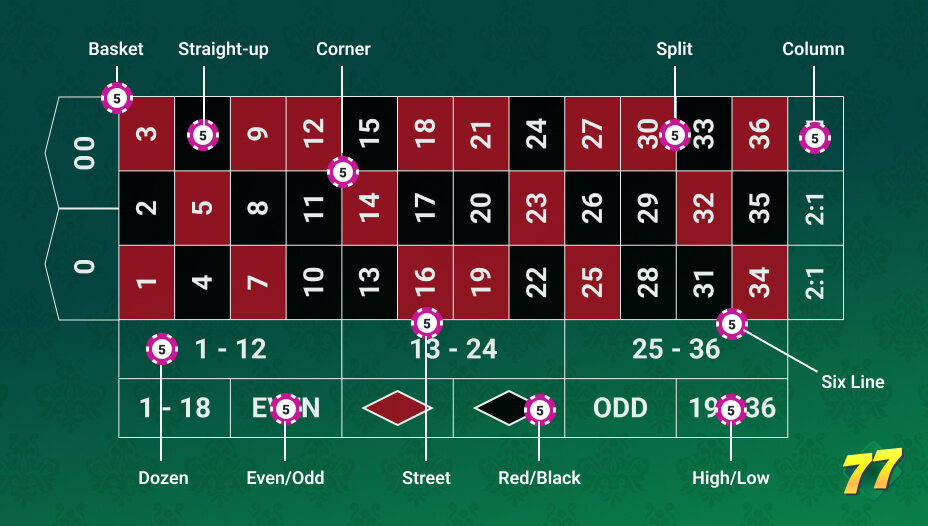
The exact odds of hitting red depend on the wheel configuration. A single-zero wheel has one green pocket. A double-zero wheel has two. The red and black sections usually still contain 18 numbers each, so the extra green pocket does not take away red numbers; it adds another way to lose. That is why the probability falls from about 48.65 percent to about 47.37 percent. The difference may look small on a single spin, but it matters over time and it changes the house edge. If you are comparing tables, check the wheel first. A table with one zero gives the red bet a better chance than a table with two zeros, even though the bet itself looks identical on the layout.
What Happens Over Several Spins
Roulette spins are independent. A red result on the last spin does not make red more likely on the next spin, and a run of black does not mean red is due. The wheel has no memory. You can calculate the chance of seeing at least one red over a series of spins, but that is different from the chance on any single spin. On a single-zero wheel, the chance of not hitting red on one spin is 19 in 37. Over two spins, the chance of no red at all is 19/37 multiplied by 19/37. The chance of at least one red is the complement of that. The same logic applies to longer sessions. These calculations are useful for understanding volatility, but they do not predict the next result. Each spin starts fresh with the same red probability.
Payout, House Edge, and Common Misunderstandings
A red bet usually pays 1 to 1, meaning a winning wager returns your stake plus an equal profit. That even-money payout is paired with a probability below 50 percent, which is where the casino's edge comes from. The edge is not a fee added to the bet; it is built into the difference between the true odds and the payout. Many players focus on the payout and forget the zero. Others assume that because red and black have the same number of pockets, the bet must be fair. It is not. The zero or zeros belong to the house, and they are the reason red is not a break-even wager in the long run. Special rules on some even-money bets can reduce the impact of zero, but they do not change the basic fact that red is not a 50/50 hit.
So what are the odds of hitting red on a roulette table? On a standard single-zero wheel, it is 18 in 37, or about 48.65 percent. On a double-zero wheel, it is 18 in 38, or about 47.37 percent. The red bet feels close to a coin flip because it pays even money and covers 18 numbers, but the green zero or zeros make it slightly less likely than that. Treat every spin as independent, check the wheel type, and remember that the red bet's real odds are always a little below 50 percent.

0 reacties
Nog geen reacties. Deel als eerste je ervaring.